The Greatest Symphony Ever Written 🎼🎻🪈
Mozart’s 41st “Jupiter” —> 4th Movement

Introduction
Wolfgang Amadeus Mozart completed his Symphony No. 41 in C Major on August 10, 1788. It was the last symphony he would ever compose. He was thirty-two years old. Three years later, he was dead.
The circumstances surrounding its creation were anything but auspicious. By the summer of 1788, Mozart’s fortunes had deteriorated sharply. Despite the triumphs of The Marriage of Figaro in Vienna (1786) and Don Giovanni in Prague (1787), steady income had dried up. Austria was at war with the Ottoman Empire, and patronage funds for the arts had all but evaporated. Mozart was reduced to writing desperate letters to his friend Michael von Puchberg, a textile merchant, begging for loans and making promises of repayment he could not keep. He and Constanze had been forced to abandon their centrally located apartment for smaller, cheaper quarters on the outskirts of Vienna. Their baby daughter had recently died.
And yet, out of this suffering, Mozart produced one of the most extraordinary bursts of creative genius in the history of Western civilization. In a span of roughly eight weeks during the summer of 1788, he composed three symphonies — Nos. 39, 40, and 41 — each a masterpiece, each utterly distinct in character, and together forming what scholars have long called Mozart’s “final great trilogy.” The conductor Nikolaus Harnoncourt argued persuasively that Mozart conceived these three works as a unified artistic statement, noting that the 41st Symphony, as the culminating work, has no slow introduction (unlike No. 39) but instead builds toward the most spectacular finale in symphonic history.
No evidence survives to confirm that Mozart ever heard any of these three symphonies performed during his lifetime.
The nickname “Jupiter” was not Mozart’s. It was almost certainly coined by Johann Peter Salomon, the London-based impresario who also commissioned Haydn’s celebrated London Symphonies. The name first appeared in English concert programs around 1813 — more than two decades after Mozart’s death. In German-speaking countries, the work was long known simply as “the symphony with the fugal ending.” Both names point to the same truth: this is a work of overwhelming power and scope, and its finale is something the world of music had never encountered before.
The 41st
The “Jupiter” is scored for one flute, two oboes, two bassoons, two horns, two trumpets, timpani, and strings. At just over thirty minutes, it is Mozart’s longest symphony. It follows the standard four-movement Classical symphonic form — fast, slow, minuet and trio, fast — but what Mozart does within that framework transcends everything he or anyone else had previously accomplished in orchestral music.
First Movement: Allegro vivace. The symphony opens with three powerful strokes of an octave C — bold, declarative, almost martial — immediately followed by a gentle, sighing figure of extraordinary tenderness. The musicologist Donald Tovey described this opening gesture as “energetic gestures alternating with gentle pleadings.” This dynamic contrast — between strength and vulnerability, grandeur and intimacy — becomes the rhetorical engine of the entire movement and, in many ways, of the entire symphony. The second and concluding themes are lighter, more rococo in character, but lightness gives way to dramatic intensity in the development section, where Mozart concentrates on the energetic first motive with remarkable power before arriving at a solid, satisfying recapitulation.
Second Movement: Andante cantabile. Mozart creates an immediate change of atmosphere by calling for muted strings. The marking andante cantabile — “at a walking pace, in a singing style” — perfectly captures the gentle forward motion and lyrical beauty of the opening theme. But serenity does not last. Sudden forte chords punctuate the opening theme, and a mood of agitation and unrest soon dominates much of the movement. The suspension-created dissonances and syncopations tear apart the graceful surface to reveal, briefly but unmistakably, genuine emotional struggle. Only toward the end does the placid opening theme return, offering a measure of resolution.
Third Movement: Menuetto (Allegretto). Some lighthearted relief arrives in the form of the Menuetto. The main section’s grace and charm are complemented by the dry wit of the trio section, which begins with two chords that sound, paradoxically, like a final cadence. It is quintessential Mozart — elegant, playful, and just slightly subversive.
The Fourth Movement: Molto Allegro — A Miracle of the Human Mind
Everything in the “Jupiter” Symphony leads to its fourth movement. And it is here that Mozart achieves something that no composer before him had ever attempted, and that arguably no composer since has equaled.
Until Mozart’s time, the first movement of a symphony was conventionally regarded as its most important and most substantial. Final movements were typically lighthearted, even lightweight — a gracious send-off for the audience. Mozart shattered this convention. In the “Jupiter,” he saved his most profound and ambitious writing for last, and in doing so, he permanently redefined what a symphonic finale could be.
The movement is cast in sonata-allegro form — the standard architectural framework of Classical music — but Mozart expanded it from within, populating it with an unprecedented number of thematic ideas and subjecting them to contrapuntal treatment of breathtaking sophistication. The movement is built on five distinct themes, each with its own character, each carefully introduced and developed:
Theme 1: The ancient four-note motif — C, D, F, E — which opens the movement. This deceptively simple figure has roots stretching back centuries into Gregorian plainchant. It can be traced at least as far as Josquin des Prez’s Missa Pange lingua from the sixteenth century. Mozart himself had used this motif before — it appears as early as his Symphony No. 1, composed in 1764 when he was eight years old, and again in his Symphony No. 33 and his Missa brevis No. 3. Here, in the “Jupiter,” it becomes the foundational building block of the most complex contrapuntal writing ever conceived for orchestra.
Theme 2: A bold, fanfare-like figure that follows immediately after the opening four-note motif, providing rhythmic energy and forward momentum.
Theme 3: A rising transitional motive that serves as a bridge, leading the music toward new tonal territory.
Theme 4: The lyrical “second theme” in the dominant key — the contrasting melody that sonata form demands, here given a singing quality that offers relief from the contrapuntal intensity surrounding it.
Theme 5: A short, angular countertheme to Theme 4, spiky in character and providing yet another independent voice in the growing web of musical ideas.
Mozart’s method throughout the exposition is extraordinary: shortly after each new theme is introduced, he subjects it to fugato treatment — a passage written in the style of a fugue, with voices entering one after another in imitation. This means the listener is hearing not merely a sequence of attractive melodies but a demonstration, in real time, of how those melodies can interact, overlap, and intertwine.
The development section concentrates almost exclusively on Theme 2, presenting it in both its original form and in inversion — turned upside down, with ascending intervals becoming descending ones and vice versa. The recapitulation is deliberately abbreviated and largely non-fugal. Mozart is clearing the stage, saving his full resources for what comes next.
The Coda: Five Themes United
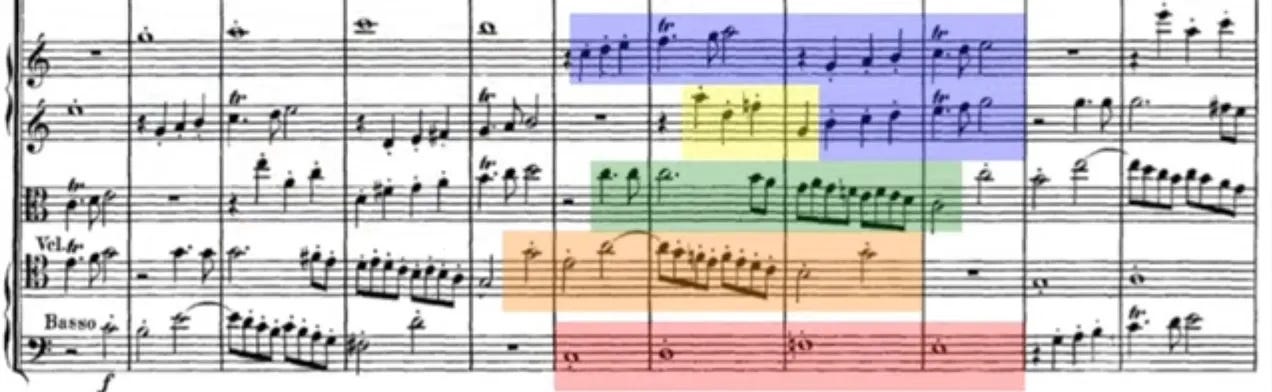
And then comes the coda.
Just when the listener believes the movement — and the symphony — is complete, Mozart unleashes the most astonishing passage of music in the Classical orchestral repertoire. Beginning at approximately measure 372, all five themes that have been introduced, developed, and explored throughout the movement are brought together and sounded simultaneously in what scholars call five-part invertible counterpoint — or, more evocatively, “quintuple counterpoint.”
This is not merely impressive technique. It is a feat of intellectual and artistic imagination that borders on the superhuman. Each of the five themes maintains its own rhythmic identity, its own melodic contour, its own expressive character — and yet they fit together with absolute precision, creating a unified harmonic and contrapuntal fabric of staggering density and beauty. The themes rotate through the orchestral registers — what begins in the first violins migrates to the violas, then to the cellos, then to the basses — cycling through the ensemble in a complete rotation while honoring the traditional subject-and-answer alternation of fugal writing. Eight entrances of the first theme occur; the vertical ordering of voices shifts with each iteration.
The musicologist Elaine Sisman, in her definitive study Mozart: The ‘Jupiter’ Symphony, described this passage in terms that capture its overwhelming effect on the listener: the coda reveals “vistas of contrapuntal infinity” and “creates a cognitive exhaustion born of sheer magnitude.”
The conductor Claudio Abbado offered a similarly vivid description: “The finale has all these ideas superimposed, bursting out, one after the other, like fireworks. There is a pile-up of musical lines, a proliferation of colors. The ingenuity is almost unimaginable, limitless.”
Sir George Grove, the great nineteenth-century musicologist, wrote that “it is for the finale that Mozart has reserved all the resources of his science, and all the power, which no one seems to have possessed to the same degree with himself, of concealing that science, and making it the vehicle for music as pleasing as it is learned. Nowhere has he achieved more.” Of the symphony as a whole, Grove declared it “the greatest orchestral work of the world which preceded the French Revolution.”
And Robert Schumann, himself one of the great Romantic composers, pronounced the “Jupiter” Symphony simply “wholly above discussion.”
This grand fugato builds to a triumphant climax — a unified crescendo brought to a close in a flourish of brass and timpani that is at once a conclusion and a coronation. It is music that sounds, paradoxically, both inevitable and impossible. That five independent melodic ideas, each compelling on its own, could be woven together into a single, harmonically coherent, emotionally overwhelming passage of orchestral music is a testament to the complexity and brilliance of Mozart’s mind. No other composer — not Bach, not Beethoven, not Brahms — ever achieved precisely this feat in orchestral writing.
A Legacy Beyond Measure
The “Jupiter” Symphony gave the world a finale that is the climax of the entire work, rather than the lighthearted afterthought that was standard in earlier symphonies. This sense of cumulative weight and seriousness was one reason the “Jupiter” remained enormously popular throughout the nineteenth century, holding its own alongside the symphonies of Beethoven — a remarkable achievement for a work composed a full decade before Beethoven’s First Symphony.
Mozart composed the “Jupiter” during one of the darkest periods of his short life. He was broke, grieving, and uncertain of his future. And yet the music itself contains no trace of despair. It is brilliant, exuberant, joyful, and overwhelmingly affirmative. It is, in the end, a statement of faith — not in any theological sense, but in the limitless possibilities of the human imagination. If a single work of art could justify the existence of our species, the “Jupiter” Symphony would be a strong candidate.
It is, I believe, Mozart’s greatest work — and the greatest symphony ever written.
The 41st Symphony
The 4th Movement
Analysis of the 4th Movement*
*magnificent coda at ~12min 00sec
Bibliography
Grapes, K. Dawn. “Mozart, Symphony No. 41, ‘Jupiter’ — Program Notes.” Fort Collins Symphony, 2023. https://fcsymphony.org/mozart-41-jupiter/
Fink, Michael. “The Story Behind: Mozart’s Symphony No. 41 (Jupiter) — Program Notes.” Rhode Island Philharmonic Orchestra, 2019. https://www.riphil.org/blog/the-story-behind-mozarts-symphony-no-41-jupiter
Grove, George. “Symphony No. 41 in C Major.” As cited in Saskatoon Symphony Orchestra program notes. https://saskatoonsymphony.org/mozarts-jupiter/
Judd, Timothy. “Mozart’s ‘Jupiter’ Symphony: An Explosion of Counterpoint.” The Listeners’ Club, 2014. https://thelistenersclub.com/2014/06/23/mozarts-jupiter-symphony-an-explosion-of-counterpoint/
Judd, Timothy. “Mozart’s Symphony No. 41, ‘Jupiter’: Celebratory Contrapuntal Fireworks.” The Listeners’ Club, 2022. https://thelistenersclub.com/2022/01/03/mozarts-symphony-no-41-jupiter-celebratory-contrapuntal-fireworks/
Pearlman, Martin. “Mozart’s Symphony No. 41 in C Major (‘Jupiter’), K. 551 — Program Notes.” Boston Baroque. https://baroque.boston/mozart-symphony-41
Sisman, Elaine. Mozart: The ‘Jupiter’ Symphony. Cambridge University Press, Cambridge Music Handbooks series.
Sydney Symphony Orchestra. “Mozart Symphony No. 41, Jupiter — Learning and Engagement Guide, Stages 5 and 6.” 2024. https://www.sydneysymphony.com/uploads/images/Teachers-Kits/2024/MOZART_Symphony-No.-41-Jupiter_Meet-the-Music-2024.pdf